
Online action and shooter games are real-time experiences built around combat, rapid decision-making, and continuous player input. Shooting mechanics are only part of what defines the genre. Perspective shapes how players read space, movement determines survival as much as accuracy does, and escalating threats force constant adaptation. This article examines the mechanics and structural pressures – perspective, positioning, weapons, enemy waves, and difficulty progression – that give these games their distinct character.
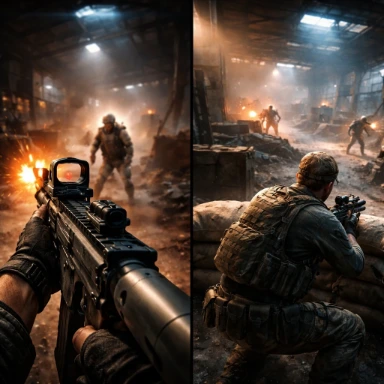
Where a player’s eyes are placed in a game determines almost everything about how combat feels, how threats register, and how quickly decisions get made. The choice between first-person and third-person perspective isn’t cosmetic – it restructures the entire combat experience.
Games like Call of Duty and Counter-Strike place the camera directly behind the weapon, simulating the player’s literal line of sight. This narrows peripheral awareness significantly, making aiming feel precise and grounded but leaving flanking threats harder to detect. Cover use becomes more instinctive than strategic – you feel exposed rather than calculate exposure.
Titles like Fortnite and Gears of War pull the camera back, giving players a wider spatial read of the battlefield. Cover mechanics become more deliberate because you can observe threats while staying protected. Aiming loses some physical immediacy, but positional awareness and battlefield reading improve considerably.
Effective play in online shooters rarely comes down to accuracy alone. Winning engagements depends on a combined skill loop where aiming, movement, and positioning reinforce each other continuously.
Raw accuracy matters, but recoil control and target tracking separate competent players from skilled ones. Recoil patterns in games like Counter-Strike 2 follow predictable sequences that players learn to compensate for manually. Target tracking – smoothly following a moving enemy – demands different muscle memory than snapping to a stationary target.
Strafing while shooting forces opponents to adjust their aim constantly, effectively reducing incoming damage without requiring cover. Faster arena shooters like Quake reward aggressive movement timing, while tactical games like Rainbow Six Siege punish reckless repositioning severely.
Controlling sightlines and map angles determines who fires first. High ground, chokepoints, and off-angles all create asymmetric advantages before a single shot is fired.
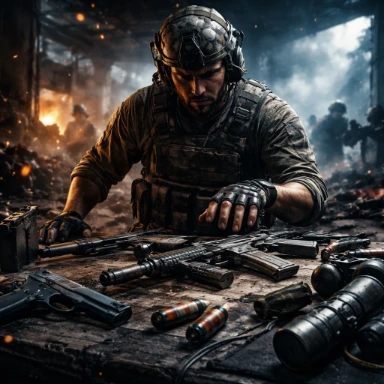
Combat decisions in online action games are shaped well before a single shot is fired. Weapon classes – pistols, shotguns, assault rifles, explosives – each carry distinct range, damage, and reload timing. Ammunition scarcity forces players to weigh aggression against conservation, often mid-fight.
Reload timing alone can determine survival. A shotgun clears close-range threats efficiently but leaves a player exposed during its slow reload cycle. Switching weapons becomes a tactical skill, not just a preference.
Many short online action games organize threats into escalating waves, with each round introducing faster enemies, altered attack patterns, or reduced resource drops. Temporary power boosts – speed bursts, damage multipliers – appear as limited counters to rising pressure.
Randomized enemy spawns and branching upgrade paths mean no two runs unfold identically. Players return not because the game changes dramatically, but because their own adaptation is always being tested differently.
Taken together, viewpoint, aiming, positioning, resource management, and escalating enemy pressure form an interlocking system where no single element operates in isolation. A player who shoots accurately but holds poor spatial awareness will still fail when enemy waves tighten the available room. Replayability in these games comes from combat scenarios that follow consistent rules but vary enough in execution to demand fresh decisions each run. Reading threat patterns and controlling space often determines survival before a single shot is fired. There’s no denying that the most durable appeal of online action and shooter games rests on that tension between preparation and reaction.