
The shift from serialized online content to interactive gaming has accelerated considerably, and adaptation is rarely as straightforward as it appears. Translating narrative, visual, and conflict structures into systems that demand player agency requires deliberate design thinking. How creators preserve what made an original series recognizable while building something genuinely playable is the central challenge this article examines – across characters, conflicts, mechanics, environments, and the productive freedom of selective reinterpretation.

Not everything that works on screen translates to a controller. The adaptation problem is really a question of selection: which elements from an online series carry functional design value, and which are simply familiar?
A character’s appeal in a series often rests on dialogue, performance, and narrative context. Strip those away and what remains must justify itself mechanically. Personality traits need to become player abilities or behavioral constraints. A calculating rival becomes an AI that punishes passive play. A reckless protagonist becomes a risk-reward mechanic. Relationships and rivalries only matter in a game if they shape decisions.
Stakes that feel urgent in a series must be converted into win conditions and failure states. A power struggle between factions, for instance, maps naturally onto territory control or resource competition. The adaptation question is whether the original conflict produces verbs. If a series conflict cannot be acted upon by a player, it belongs in a cutscene, not a core loop.
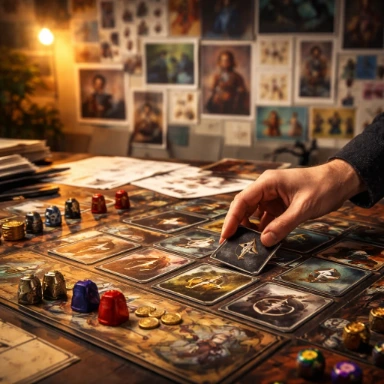
Mechanical choices carry meaning, and when adapting an existing property, those choices either reinforce what audiences already feel about a story or quietly contradict it.
A series built on deception and shifting alliances, for example, calls for mechanics involving hidden information or betrayal rather than straightforward combat progression. Forcing a stealth-driven narrative into a resource-management framework creates friction that players sense immediately, even if they can’t articulate why. The thematic logic of the source material should function as a design constraint, not a suggestion.
Environments adapted from screen properties carry embedded expectations about pacing and affordance. A cramped urban apartment from a crime thriller should feel claustrophobic in layout, limiting sight lines and compressing player movement. Environmental storytelling – scattered objects, ambient audio, lighting – can replace expository text while deepening immersion. When level flow mirrors the tension structure of the original narrative, the adaptation earns its identity.
Fidelity in adaptation is rarely about reproduction. The most effective game versions of online series succeed not by recreating scenes or replicating dialogue, but by translating the emotional logic of their source into systems players can inhabit directly. A conflict that unfolds across episodes can become a progression structure; a tone that defines a show’s atmosphere can shape an entire visual and audio design language. Challenges built around a source’s themes feel authentic even when they introduce entirely new scenarios, because what players recognize is the underlying tension, not the surface detail. Strict scene-by-scene duplication tends to produce passive experiences that contradict what games do best. The design lesson that holds across most successful adaptations is this: fidelity matters most at the level of experience and conceptual essence, not literal reconstruction.